The $94.5M Legend: Jim Irsay's Auction Breaks 28 World Records
Yes, the guitars were historic. Dave Gilmour’s Black Strat sold for $14.55 million, the most ever paid for a guitar at auction, full stop. Jerry Garcia’s Tiger went for $11.56 million, and Kurt Cobain’s Smells Like Teen Spirit Mustang brought $6.9 million. Remarkably, nine of the top 21 guitar sales in auction history happened in one room over one week in March. The coverage was real and it was earned.
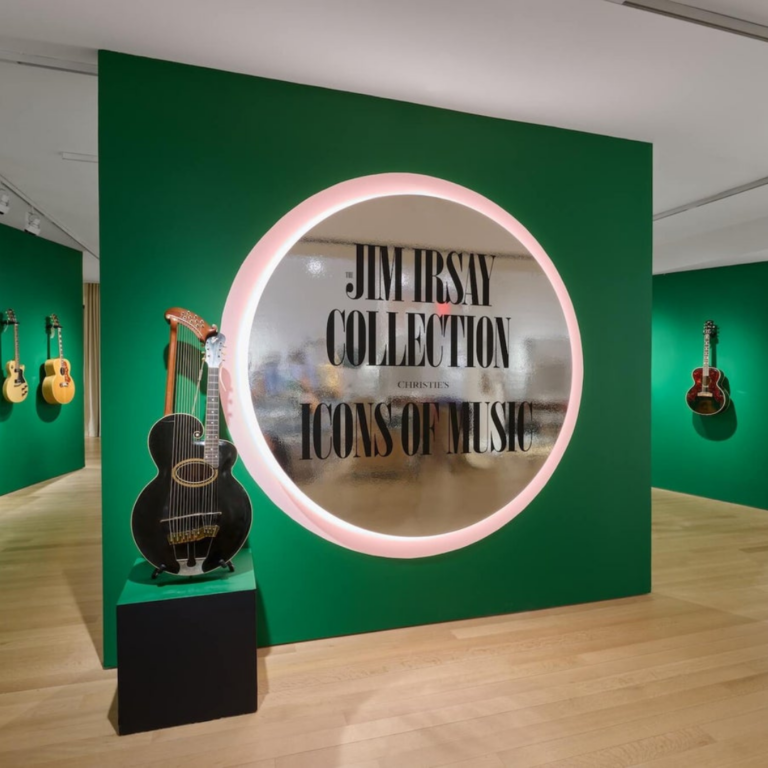
But the Jim Irsay auction at Christie’s wasn’t just a guitar sale. It was four days, $94.5 million, and 28 world records broken across music, literature, sports, and American cultural history. Christie’s estimated the whole thing at $40 million, yet it sold for more than double that. Every single lot sold.
Most of those records have barely been mentioned, because the guitar numbers were so staggering they swallowed everything else in the room.
The Guitars First, Because They Earned It
The Black Strat is the lead story. Gilmour’s primary Fender Stratocaster for decades, the guitar behind Comfortably Numb and Shine On You Crazy Diamond and the core sonic identity of Pink Floyd, crossed the block and landed at $14.55 million. Irsay had bought it in 2019 for $3.975 million, itself a world record at the time. In just seven years, it nearly quadrupled in value.
Garcia’s Tiger was built by luthier Doug Irwin over six years, delivered in 1979, and was the last guitar Garcia played at the Grateful Dead’s final Soldier Field show in 1995. It sold for $11.56 million. Cobain’s lake placid blue Fender Mustang, used in the Smells Like Teen Spirit video and across the Nevermind and In Utero touring cycle, went for $6.9 million. Meanwhile, Eric Clapton’s MTV Unplugged Martin 000-42 sold for $4.1 million. His colorfully painted Gibson SG known as The Fool set a new record for any Gibson guitar at $3 million, and George Harrison’s Gibson SG Standard brought $2.27 million.
In total, the guitars alone set records that will define the instrument’s auction market for years. Still, they were only part of the story.
28 World Records. Most of Them Went Unnoticed.
Christie’s confirmed 28 world records broken across four sessions at the Jim Irsay auction. The guitar records dominated the headlines, which meant almost everything else got buried. Here’s what people missed.
John Lennon’s upright Broadwood piano, the one he used at home while writing songs for Sgt. Pepper’s including Lucy in the Sky with Diamonds and A Day in the Life, was estimated at $400,000 to $600,000. It sold for $3.247 million. That’s a world record for any Beatles object ever sold at auction, and it received almost no coverage while the guitars were sitting three rooms over.
Beyond that, Miles Davis’s Martin Committee trumpet sold for $1.651 million, a world record for any trumpet at auction. Secretariat’s 1973 Triple Crown saddle, the one Ron Turcotte rode during what many still consider the greatest performance in horse racing history, sold for $1.524 million, a world record for any horse racing item. Wayne Gretzky’s Edmonton Oilers jersey from the night he scored his 500th NHL goal went for $952,500. Additionally, Muhammad Ali’s fight robe from the Ali-Liston rematch, his first public appearance under his new name, sold for $444,500.
And then there’s the Mead notebook. A spiral notebook containing 28 handwritten pages of Sylvester Stallone’s original Rocky script sold for $508,000. Someone paid half a million dollars for a Mead notebook. That’s this auction in one sentence.
The Kerouac Scroll Nobody Is Talking About
The single most surprising result of the entire Jim Irsay auction might not be a guitar at all. Jack Kerouac’s original On the Road typescript, the continuous 120-foot document he typed in 1951, was estimated at $2.5 to $4 million. Instead, it sold for $12.135 million, a world record for any literary manuscript at auction, ever.
The buyer was country artist Zach Bryan, who is converting a church in Lowell, Massachusetts, Kerouac’s hometown, into a Jack Kerouac cultural center. Of everything that sold across four days at Christie’s, this one probably has the most meaningful second life.
Who Was Jim Irsay
Irsay owned the Indianapolis Colts from 1997 until his death in May 2025 at 65. Born in 1959, he grew up with all of it happening in real time. The Beatles on Ed Sullivan. Ali changing his name. Dylan going electric at Newport. Cobain arriving like a detonation. He didn’t just watch it happen. Instead, he spent decades tracking down the physical objects at the center of those moments.
He bought the Kerouac scroll at Christie’s in 2001, and that purchase kicked everything off. He later acquired Dylan’s Newport Folk Festival electric guitar from the pilot’s daughter, the guitar Dylan had left on a private plane after the infamous 1965 set that scandalized the folk world. Since Irsay was a guitarist himself and a member of the Jim Irsay Band, his relationship to these instruments was never passive. He hunted them down because he understood what they were.
Before the auction, the collection toured the country as a traveling exhibit, shown at the Rock and Roll Hall of Fame, the Metropolitan Museum of Art, and the British Library. Fans came not to bid but simply to stand near these things. After Irsay died, his family put it all up for sale, with a portion of the proceeds going to the philanthropic causes he had supported throughout his lifetime.
Why the Guitars Got All the Attention
Three of the four most expensive guitar sales in auction history came from this single event. That concentration of enormous numbers at the very top pulled all the oxygen out of the room for everything else.
Even so, the broader story is more interesting. The Jim Irsay auction wasn’t built around any single category. Rather, it was a lifetime’s worth of deliberate decisions about what mattered, about which objects deserved to be preserved and which stories were worth keeping physical. Guitars, manuscripts, saddles, notebooks, drum heads, pianos.
Twenty-eight world records and $94.5 million later, the market gave its verdict on those decisions. The guitars got the headlines, and they deserved them. But they were only part of what this man spent his life collecting, and only part of what sold.
Sources
- Christie’s Official Press Release — $94.5M total, 28 records, 100% lots sold
- ARTnews — Christie’s $94.5M Jim Irsay Sale Sets 28 Records
- ESPN — Jim Irsay’s memorabilia collection nets over $93M at auction
- Bleacher Report — Jim Irsay Collection Sells for $94M, See List of Records
- Guitar World — Jim Irsay Collection guitar auction breaks world records (final results)
- Guitar World — World record for most expensive guitar shattered three times in one night
- New Atlas — Irsay auction recalibrates music memorabilia record books
- Sports Illustrated — Beyond the Guitars: Record Sales From The Jim Irsay Collection Auction
- Sports Illustrated — Cobain, Jackie, Secretariat & More: The Jewels of Jim Irsay’s Collection
- NBC News — Inside Jim Irsay’s rock ‘n’ roll time capsule heading to auction at Christie’s
- Fox News — Late Colts owner Jim Irsay’s memorabilia collection brings record prices at auction
- NPR — Musical treasures collected by late Indianapolis Colts owner up for auction